
I Finally Cried
Reflections on My Health Event

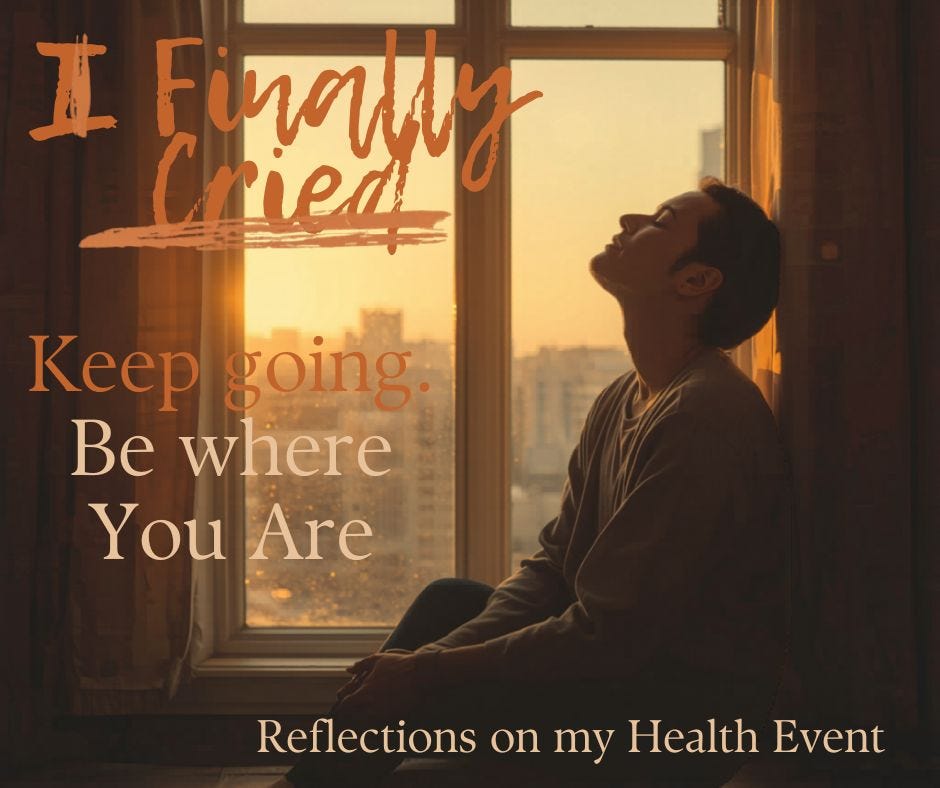
I realized the other day that I hadn’t cried in a while. It’s not that I keep track, or that I cry often, even though I cry more than I used to. But all of a sudden, I found myself weeping for the first time since my heart event on March 9th. It wasn’t the overwhelming gravity of the fact that I almost died several months ago. It wasn’t the challenge of recovering from a new event 4 years after my stroke. All of that is huge, and because I am inclined not to bypass it now, I felt ready to face the uphill battles, including my mental health.
It was, as it almost always is, a song that let me know I could take a break from pushing through all the challenges and, as I did after my stroke, acknowledge that this is going to be hard. In case you’re wondering, it’s not feeling sorry for myself; it’s accepting the gravity of what I will have to face. It’s things like trying to build up cardio when you’re limited in mobility—It’s daily walks that are harder when you live on the side of a bluff—It’s balancing medications and managing pain—It’s an endless stream of frustrations, small victories, and irrational meltdowns that almost always feel like two steps forward, then two steps back.
The song was “Keep Going” by Jada Monroe, an AI-generated soul and blues singer/songwriter from Mississippi. I would suggest listening to the song first before reading further. Listen here. The words are listed below.
The heart event I experienced came suddenly one night after I had overexerted myself. Since everything has good and bad sides, I always partially attribute things like this to my tendency to push through. It helped me achieve things in my life, but it’s probably also part of my health issues. We can’t keep pushing through and ignoring the things that challenge us. Sometimes we have to slow down, sometimes we have to change the course, and sometimes we need to rest.
On the night of my heart attack, I received CPR and a shock to restore responsiveness. They rushed me to a larger hospital for catheterization and to place a couple of stents to keep me alive. Within two weeks, they went back in to finish the job and placed more stents to get my blood flowing. My heartbeat still had some irregularities, so shortly thereafter, I was scheduled for an ablation, which corrects conditions like AFib and fluttering heartbeats. All of these were successful, but the two months felt like I was constantly managing appointments, organizing meds, and forcing myself to sleep.
“Be where you are.”
This statement is part of my tagline, which we use on our podcast and in my writing. It has taken on a deeper meaning through this new, challenging event I’m experiencing. Jada Monroe’s song helped me feel it, which is why I cried. For three minutes and 27 seconds, I wasn’t planning my next moves or my daily schedule—I was feeling what the song intended.
In case you missed it earlier, Jada Monroe is not even a real person. She is AI-generated. So how can I explain how something created by a human and a machine could be exactly what I needed 1 week ago? I can’t. Feeling like I need to explain it is part of the problem.
I simply needed to be present and accept that my body knew better than my brain what it needed to feel. I stayed present long enough to feel it, experience it, and accept the healing that came from this unlikely place.
Acknowledge that it is hard.
I must lead with the fact that I’ve been on a lifelong quest to find the secrets I imagined were out there for hacking the system. When I was a pastor, I always asked those who were more successful what their secret was and how I could apply it. They usually said something to the effect of, “Keep doing what you are doing.” After I succeed at something, I immediately start looking for strategies to do it better. Employers generally liked me because I was self-motivated, but we would eventually clash because they weren’t as stubbornly committed to change as I was.
So, I started over several times and worked through the challenges of building and rebuilding. The drive to find techniques and strategies that would make life easier led me to conclude that most positive change is hard. That’s it! We shouldn’t waste our time searching for magic solutions, whether in religion or the latest management book. We should spend our energy discovering the truth about what it takes to improve, change, and commit ourselves to the hard work. This grounds our endeavors in truth rather than wishful thinking.
When I had my stroke 4 1/2 years ago, Laura and I looked at each other after receiving the news. We didn’t pray or read a book about strokes right away. We simply looked into each other’s eyes and said, “This is going to be hard.”
Acknowledge that we can’t change “where we are” instantly
People who read what I write may assume I have nothing positive to say about religion. Because I ask hard questions and point out deficiencies, many assume I am angry or have a vendetta. That’s simply not true! I believe there are benefits to community and groups, but for about 1600 years, we’ve been doing it all wrong.
Much of the language within Christianity lends itself to thinking about instant, miraculous change. It stresses, “I once was lost, but now I’m found.” It sings of instantaneous transformation and 180° directional shifts, which often leave followers confused and dismayed because that’s not their reality. The reality is that change takes time, and even if we find the right God or the right religion, our nervous systems don’t repair themselves instantly. There are helpful practices, but no magic solutions.
It takes not only effort but also time!
Acknowledge every win.
I remember my first step after the stroke. I also remember my first breath after being resuscitated. The therapist who helped me learn to walk again took time to celebrate my first step. Of course, it was followed by encouragement to take another, and then another, until months later, I could walk with a cane. My first breath after they resuscitated me felt like my body was rebooting. My body instinctively knew to breathe and hum so that everything could begin to come back online. Fortunately, the EMTs knew I needed more help and rushed me to St. Joseph, MO. But they paused to celebrate that I was alive.
I don’t think we need extravagant parties every time we do something. But I do think we need to acknowledge every success, no matter how small we have convinced ourselves it is.
Celebrate every milestone! Acknowledge that it’s hard! Realize it’s a journey!
Be where you are, Be who you are, Be at peace!
Karl Forehand
Thank you for sharing, I too have had a similar experience, one has to listen to their body and rest when it says to rest, thus article really spoke to me❤️
What do you see as the current problems?