
The Problems with the Flood
An Honest Critique of Noah's Flood

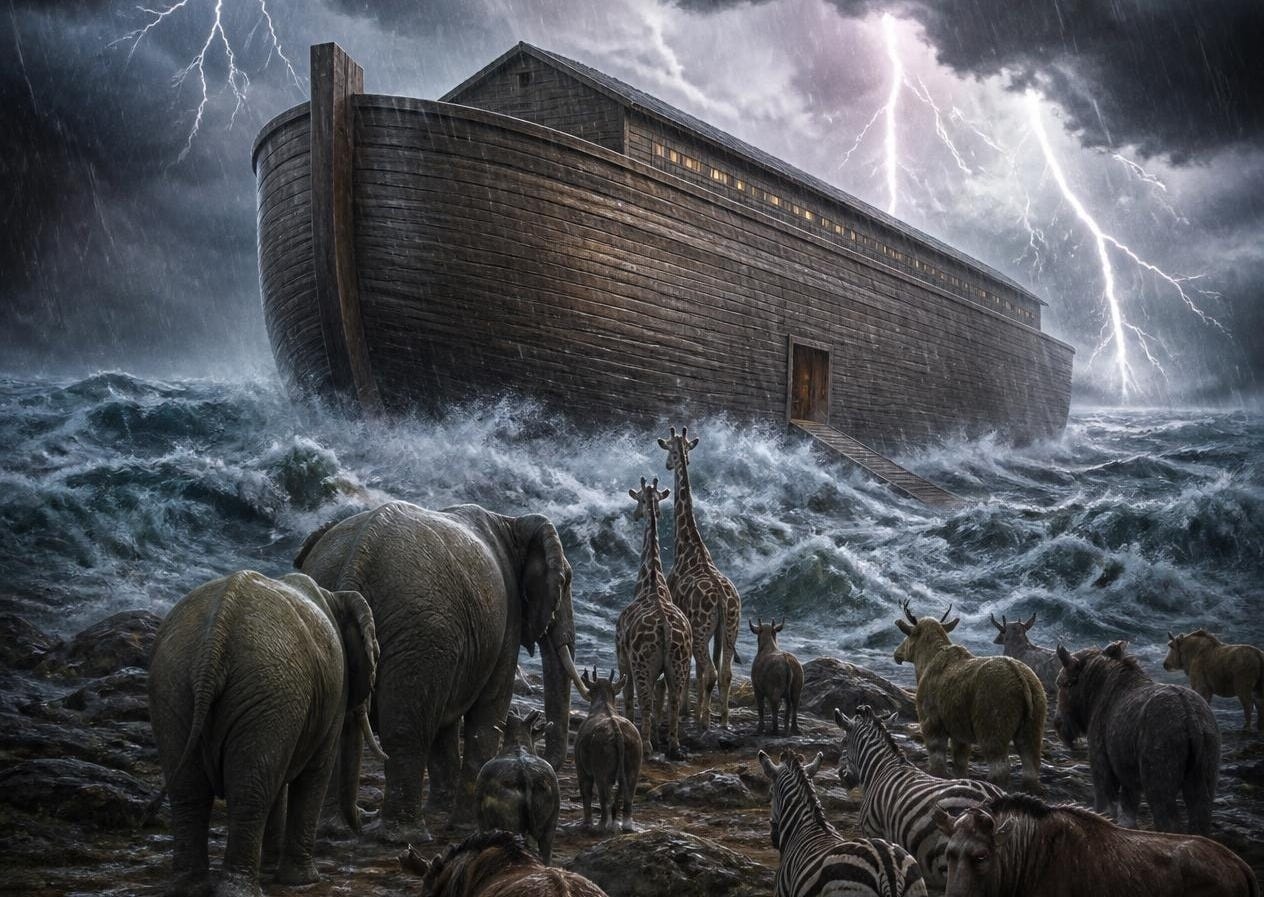
The narrative: Six chapters in, the Bible explains that the world was so evil that God destroyed almost everyone and everything, and the rainbow was a promise that he wouldn’t do it again.
I realize that any story can be spiritualized or excused with magical explanations. But after 50 years in Christianity and 20 years as a pastor, I grew tired of every biblical story being explained by God’s magic rather than by science, logic, or reason. The Word (logos) means logic and reason, not “I don’t know, I guess God magically did it?”
The biblical stories often lack devotion to the physical world and the natural laws we can observe, prove, and reproduce. If you knew a guy who explained all his logic or all his stories with magic, it would only take a couple of times before that man’s stories would become suspect.
Failures of the Flood
What does not make sense about the flood narrative, and what scientific reasons explain why it never happened?
We know from archaeological excavations and other historical evidence that the flood narrative was not specific to the Jewish people. There were many narratives about global or regional floods before and after the Genesis account of what Yahweh or other gods allegedly did to the world.
Most of us were indoctrinated with this story as young children and taught to simply accept it as truth without questioning it. I have never heard a religious teacher, pastor, or Sunday School teacher address the concerns with this story for more than 1 minute. Somehow, the religious community adopted Ken Ham as their spokesman for this issue and their creator for the Ark Encounter in Kentucky. If you saw him debate Bill Nye, you know he has very little to offer and that he suffered an embarrassing defeat. The scientific evidence he ignores is alarming.
Spiritual/Theological Problems with the Narrative
Noah’s Flood narrative poses several profound spiritual and theological challenges that scholars, believers, and critics have debated for centuries.
The Problem of Mass Destruction
One of the main problems with the flood narrative is that it challenges the concept of an all-loving, merciful God. The drowning of infants, children, and animals raises deep moral questions about what kind of God would do that. For me, everything centers on my children, and I could never imagine drowning or torturing them, even for the worst crimes. They have no chance of redemption or reformation when they are mercilessly suffocated underwater. There is no plan of redemption in the flood. They all died!
Wiping out entire populations is in contrast with the principle of individual accountability that Christianity proposes. The concept championed in the flood is similar to wiping out entire nations, even though it may be only a few parts of the population that are leading and influencing “evil” in that nation. Christians would never imagine God destroying the entire United States and all of its inhabitants because we have a high crime rate. The flawed narrative teaches that it would be the states in the South that are the most violent that would be destroyed, or simply the perpetrators (even though that still doesn’t solve the problem). We can imagine God destroying our enemies, real or imagined, but we never even imagine God wiping out the entirety of the United States under any circumstance.
After the flood, he is said to regret creating humanity. While this is an act of accountability on his part, it also suggests a lack of divine foreknowledge, which the biblical narrative attributes to him. These ideas conflict and don’t resolve. The dialogue recorded in Genesis portrays a largely unstable being who reacts by shifting from extreme anger to total destruction. A perfect creator who needs to hit the “reset button” also implies that the original design was inherently flawed.
The Failure of the Reset
In my experience in Sunday school and other Bible-teaching environments, the Noahic flood was portrayed as a divine judgment that resolved the problem of human wickedness. After years of contemplation, study, and preaching about the flood, I find no evidence that it cured human wickedness. The first example appears immediately after the flood, when Noah acted inappropriately toward his sons. Look it up!
If human nature remained unchanged, the global loss of life and worldwide destruction yielded no permanent spiritual cure for the issue. The fact that God promised not to do it again lends credence to the idea that it didn’t work, didn’t solve the sin issue, and wouldn’t work in the future. The flood was a total failure, as evidenced by God’s actions afterward and by the human response to the punishment.
The humans who subsequently descended from the “good guys” in the flood story still suffered from the same human condition that had existed before the flood. As they reproduced through incest, they continued to face the same issues they had before. It accomplished nothing!
If God promised never to flood the earth again and that didn’t solve the problem, we have to admit that God made a mistake.
Theological Inconsistencies
As with other parts of the Bible, the Old Testament/Hebrew Scriptures’ narrative of retributive justice contrasts sharply with the restorative justice portrayed in parts of the New Testament/Christian doctrine. Christianity goes to great lengths to reconcile these problems, but in my opinion, there’s very little progress in the 1700 years we have had a Canon to examine and a faith to question. The murder and genocide simply don’t coexist very well with things like the Golden Rule and loving your neighbor.
For me, the overriding conviction is that after over 30 years of serious study of the Bible and 20 years as a pastor, I find very little evidence that God has ever truly transformed people (much like He didn’t after the Flood). I have heard testimonies of people overcoming addictions and attending church more, but in my experience, the most serious Christians and other religious sects are just as disgusting and unchanged as the groups they don’t like. A dedicated, dyed-in-the-wool Southern Baptist will hold the same beliefs he had at seven and still believe stories and myths about a retributive God who doesn’t have a problem with slavery, genocide, and other atrocities like the Flood. They are just as likely to endorse terrorism, slavery, and genocide as any other country they despise (for example, the latest invasion of Iran). The SBC routinely covers up the most heinous abuse of women and children and claims it is sanctified (transformed, set apart). I could go on and on about their failures to transform/change.
Spirit-filled Christians are often the most judgmental and hateful people you can meet. They pull out divine-judgment stories when it suits their needs, then talk about love, grace, and mercy in their marketing. The story of the flood, as portrayed in Genesis and believed by the flock, should be the most embarrassing part of their collection of myths and stories; instead, they hold it up as a threat to drive the sheep to the altar.
The Scientific Issues
The main problems with the Biblical account of Noah’s Flood center on conflicts with established scientific fields. Most people can accept some mystery and magic in their stories, but when a story violates every tenet of natural law, it becomes suspect. For example, maybe God can cause an elephant to migrate toward a ship in the middle of a desert, but it’s unlikely that he would miniaturize an elephant into a hatbox. We can believe that Jesus turned water into wine, but it’s unlikely that alcohol has no effect on the body.
And if we are honest, most miracles are not verified, and they very rarely happen. When a huckster hypes an audience, deception becomes easier, and disproving the person in charge is discouraged. As any magician, showman, or charismatic preacher knows, people are easy to deceive, especially when they want to believe.
Geology and Archaeology
There’s no uniform global sediment layer or fossil record evidence corresponding to a single worldwide flood. It simply doesn’t exist! Late at night, I often watch shows centered on archaeological digs into ancient civilizations, and sometimes even those directly related to the investigation of the biblical record. Time after time, one thing is consistently absent: proof of the biblical record. When they dig through the actual places where things were supposed to have happened, they find evidence of all kinds of things, except for things like the ark and other things that are supposed to be there.
Occasionally, the archaeologist, who is sometimes trying to verify the biblical narrative, sadly says that it may be just a story based on other stories told at the time. Several times, people who wanted Noah’s flood story to be true have claimed to have found the site, but when it is actually explored, it lacks evidence. In my mind, it’s OK to keep looking for that evidence, but it is inauthentic to say it actually happened when there is no proof.
Continuous historical records and architectural evidence from ancient civilizations (such as Egypt and Mesopotamia) indicate uninterrupted continuity throughout the proposed timeframe of the flood, with no record of the flood narrative.
By the way, archaeologists face the same difficulty proving that Sodom and Gomorrah were real places or that Jericho fell as the Bible describes. It clarifies a lot for me to see how much irrefutable evidence there is documenting and explaining Egyptian culture and history, yet the evidence for the biblical narrative and history essentially does not exist. When the narrative was written in 1500 BC about topics such as creation and the Noahic flood, it is fairly obvious that it is based on earlier stories.
Biology and Zoology
It’s very difficult for Christians to explain how a single wooden boat could physically accommodate or feed millions of animal species; nor can it explain how koalas and kangaroos reached the ark or survived without their natural food. Questions include how the meat eaters survived without destroying the creatures God was trying to preserve, or how they survived immediately after the 40 days, when the Biblical text says that everything was destroyed. The eucalyptus needed for a koala to survive would have had to magically grow in the desert, where it didn’t grow at any other time in history.
Again, to make the story make sense, we have to jump through so many hoops that defy logic, reasoning, and the basic rules of science, specifically biology and zoology. I could raise 100 puzzling questions about the flood and how the animals and people survived and continued to survive after the ark, but all the biblical literalists can offer are wild assumptions about what might have taken place. And again, there is no evidence to support these stories.
Genetics
Reducing global human and animal populations to single pairs or small family groups a few thousand years ago would have created extreme genetic bottlenecks, leading to fatal inbreeding. Among other things, human diversity would have been stripped away because the entire future global population would inherit only the genetic material of those few survivors. Humankind would have lost its adaptive potential without genetic diversity. In small, inbred populations, offspring are far more likely to inherit 2 copies of harmful recessive genes. The Minimum Viable Population rule often suggests a minimum of 50 individuals to prevent severe inbreeding depression and 500 individuals to offset long-term genetic drift.
Modern genomic sequencing reveals no evidence of a global single-pair bottleneck in humans or other animal species within the last 10,000 years. While human history includes localized bottlenecks such as the Toba catastrophe candidate event 10s of thousands of years ago, human genetic diversity today reflects A continuously effective population size that never dropped to a single family.
By the way, they also despised any magical explanation for anything that didn’t fit their narrative.
Physics & Meteorology
The atmosphere cannot hold enough water vapor to cover the Earth’s highest mountains; condensing that much water would also generate catastrophic atmospheric heat. If all the water vapor in the atmosphere condensed at once, it would form a global layer of liquid water only about 1 inch deep. Air temperature limits how much water the atmosphere can hold, and even if the air were fully saturated worldwide, there is nowhere near enough total atmospheric volume to submerge high-elevation terrain.
The “Fountains of the Deep” (subterranean water) is under immense lithostatic pressure and at temperatures exceeding 1000°C. Calculations show that venting the superheated fluid into the atmosphere would release enough latent and thermal heat to raise atmospheric temperatures to thousands of degrees, boiling the existing oceans and instantly destroying all life on the surface, including anything aboard an ark. The reality of releasing this underground water is too complex to address in this blog, but suffice it to say that this theory creates far more problems than it solves.
Closing
I realize that any story can be spiritualized or excused with magical explanations. But after 50 years of encountering these limited explanations in Christianity and 20 years as a pastor, I grew tired of every biblical story being explained by God’s magic rather than by the science that explains everything else. We can’t say that biblical stories lack devotion to the physical world and the natural laws we can observe, prove, and reproduce. If you knew a guy who explained all his logic or all his stories with magic, after a couple of times, his stories would become suspect.
Be where you are, Be who you are, Be at peace,
Karl Forehand